
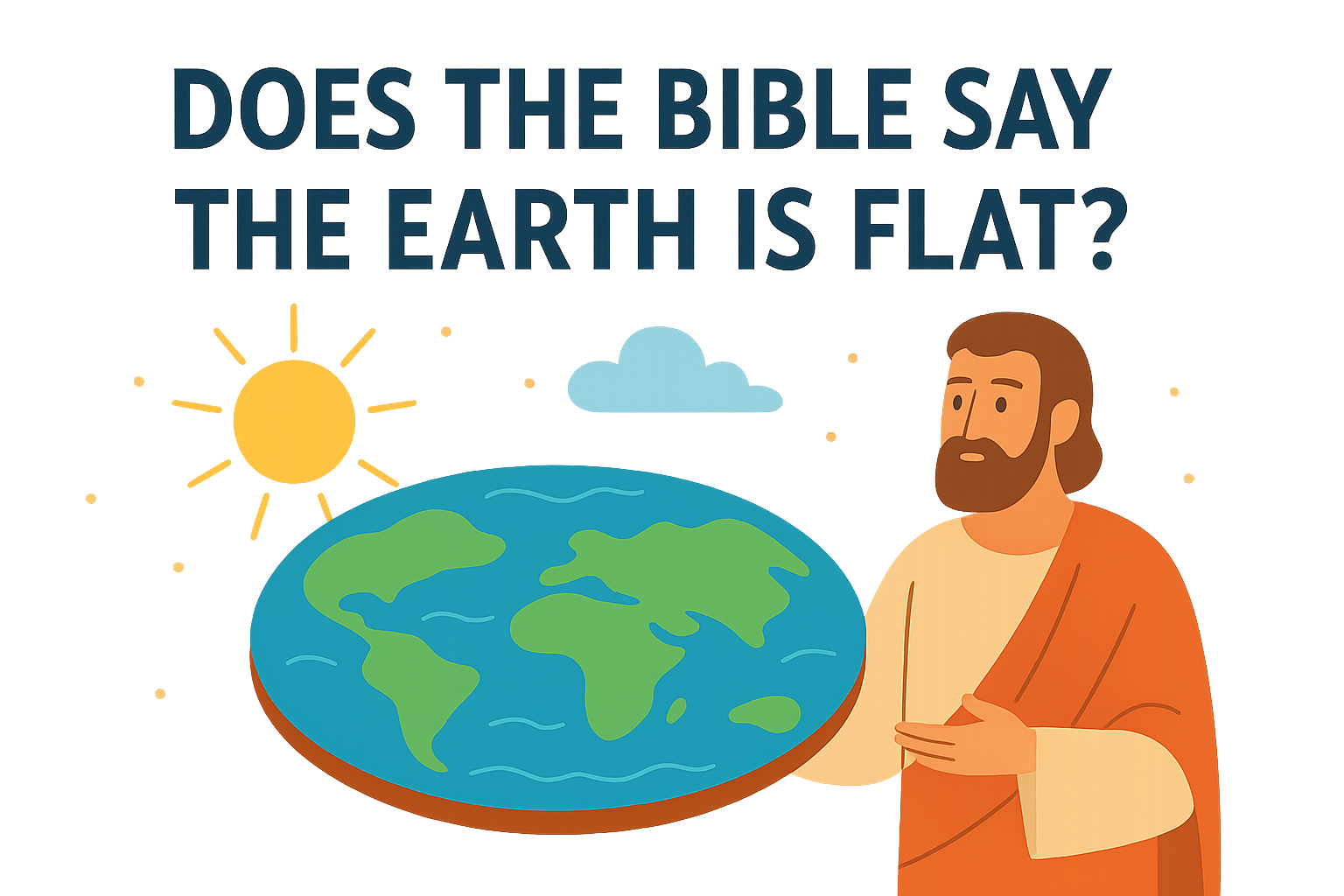
The Bible does not explicitly state that the Earth is flat. Many passages can be interpreted in various ways, and the understanding of the Earth’s shape has evolved over time. While some verses might seem to suggest a flat Earth, a closer examination reveals that these interpretations often stem from cultural contexts or figurative language rather than a definitive claim about the Earth’s shape.
Throughout history, the belief in a flat Earth was common due to the limited scientific knowledge of the time. However, as our understanding of the universe has grown, many people now recognize that the Earth is a sphere. This article will explore relevant Bible passages and their interpretations to address the question of whether the Bible supports the idea of a flat Earth.
Understanding Biblical Imagery and Language
The Bible often uses figurative language, metaphors, and poetic imagery. These literary devices can lead to various interpretations of certain passages. For example, when the Bible refers to “the four corners of the Earth” in Isaiah 11:12, it is not necessarily suggesting a flat surface. Instead, this phrase is understood to symbolize the entirety of the Earth, encompassing all directions—north, south, east, and west.
Isaiah 11:12
“He will raise a banner for the nations and gather the exiles of Israel; he will assemble the scattered people of Judah from the four corners of the Earth.” (Isaiah 11:12, NLT)
In this context, “four corners” is a poetic expression rather than a literal description of the Earth’s shape. The imagery conveys a sense of completeness and inclusivity, indicating that God will gather His people from all parts of the world.
Ancient Cosmology in the Bible
Understanding the cultural context in which the Bible was written is essential. Ancient Near Eastern cosmology often depicted the Earth differently than modern science. The Hebrews, like many ancient peoples, viewed the Earth as a flat disk floating on water, with a solid dome above it called the “firmament.” This view is reflected in some biblical passages, but it does not imply that the Bible teaches a flat Earth in a definitive sense.
Genesis 1 and the Firmament
In Genesis 1, the creation account describes the firmament as a barrier separating the waters above from the waters below (Genesis 1:6-8). This description aligns with ancient cosmological views and serves a specific theological purpose rather than providing a scientific explanation of the Earth’s shape.
“And God said, ‘Let there be a vault between the waters to separate water from water.’ So God made the vault and separated the water under the vault from the water above it. And it was so. God called the vault ‘sky.'” (Genesis 1:6-8, NLT)
This passage illustrates God’s creative power and sovereignty, emphasizing the order He brings to creation. While the imagery may suggest a flat Earth, it is important to recognize that the primary purpose of this text is theological and not scientific.
Other Biblical Passages and Interpretations
Several other passages are often cited in discussions about the Earth’s shape. For instance, some point to Job 26:7, which states that God “stretches out the north over empty space and hangs the Earth on nothing.” This verse has been interpreted by some as supporting a spherical Earth, as it implies that the Earth is suspended in space rather than resting on a flat surface.
Job 26:7
“He stretches out the northern skies over empty space; he suspends the Earth over nothing.” (Job 26:7, NLT)
Such interpretations highlight the complexity of the text and the importance of considering the original language and context. The imagery of the Earth being “suspended” can be seen as compatible with a spherical understanding of the planet.
Tradition vs. Scripture
Throughout history, certain traditions have influenced how Scripture is interpreted. The idea of a flat Earth was more prevalent in earlier centuries, but as scientific discoveries advanced, many scholars and theologians began to reevaluate these interpretations. It is essential to differentiate between what the Bible explicitly states and what has been inferred or traditionally believed.
- Scripture: The Bible does not provide an explicit statement that the Earth is flat.
- Tradition: Some historical interpretations leaned toward a flat Earth view.
- Modern Understanding: Scientific evidence supports a spherical Earth.
This distinction is crucial for understanding how biblical texts should be approached today. While the Bible may reflect ancient cosmological views, it is not a scientific textbook. Instead, it conveys spiritual truths and God’s relationship with humanity.
Conclusion of Part One
In summary, the Bible does not clearly state that the Earth is flat. Various passages may seem to suggest this idea when taken out of context or interpreted literally without considering figurative language and ancient cosmology. Understanding the cultural and historical background of the texts helps clarify their intended meanings. As we continue to explore this topic, we will delve deeper into specific passages and interpretations to further clarify the Bible’s stance on the shape of the Earth.
Exploring the Theological Implications
When discussing the shape of the Earth in relation to the Bible, it is essential to consider the theological implications of the texts rather than just their literal interpretations. The primary purpose of Scripture is to reveal God’s nature, His relationship with humanity, and His plan for creation. In this light, the shape of the Earth may not be a focal point of biblical teaching. Instead, the emphasis is often on God’s sovereignty and power over creation.
For instance, in Psalm 104, the psalmist poetically describes the majesty of God’s creation, highlighting His control over the natural world. This passage underscores the idea that God’s creative power is paramount, regardless of the physical characteristics of the Earth. The focus remains on worship and reverence for the Creator rather than the specifics of the created order.
Psalms and Creation
In Psalms, we find numerous references to God’s handiwork in nature. These verses convey the awe and wonder of creation, encouraging believers to praise God for His design. The psalmist’s intent is to lead readers to marvel at the Creator, rather than to provide a scientific explanation of the Earth’s structure.
Scientific Insights and Biblical Harmony
As scientific understanding of the Earth and the universe has developed, many Christians have found ways to harmonize their faith with scientific discoveries. The belief in a spherical Earth is not inherently at odds with biblical teaching. Many theologians argue that the Bible’s primary focus is not on the specifics of physical cosmology but on spiritual truths that transcend scientific inquiry.
For example, the concept of God as the Creator who orders and sustains the universe aligns with both biblical teaching and scientific understanding. The Earth, whether seen as flat or spherical, is still a part of God’s creation, and this truth holds significance for believers. The Bible invites exploration and discovery, encouraging believers to seek knowledge about the world while acknowledging God’s ultimate authority over it.
The Role of Faith in Understanding Creation
Faith plays a crucial role in how believers interpret both Scripture and scientific findings. While some may feel that accepting a spherical Earth undermines biblical authority, others view it as an opportunity to deepen their understanding of God’s creative work. This perspective fosters a sense of wonder and appreciation for the intricacies of the universe, encouraging believers to explore their faith in light of new knowledge.
Contextualizing Biblical Passages
To fully understand the biblical passages related to the Earth’s shape, it is important to consider the context in which they were written. Ancient texts reflect the views and knowledge of their time, often using language that resonates with contemporary audiences. The Bible’s cultural context informs its literary style and the way it conveys truth.
For example, the use of terms like “the ends of the Earth” or “the four corners” does not necessarily indicate a flat Earth worldview. Instead, these phrases can be construed as expressions of totality and inclusiveness, emphasizing God’s authority over all creation. Recognizing the metaphorical nature of such language allows readers to appreciate the depth of biblical teaching without getting mired in literal interpretations.
The Importance of Hermeneutics
Hermeneutics, the study of interpretation, is crucial when approaching biblical texts. Different genres within the Bible—such as poetry, history, and prophecy—require different interpretive strategies. Understanding the literary genre and the author’s intent can lead to more accurate interpretations and a better grasp of the overall message of Scripture. This approach encourages believers to engage with the text thoughtfully and critically, rather than relying on simplistic or outdated interpretations.
Questions for Reflection
As we consider the relationship between Scripture and the shape of the Earth, several meaningful questions arise:
- How does our understanding of the Earth’s shape influence our view of God’s creation?
- What role does faith play in reconciling scientific discoveries with biblical teachings?
- In what ways can we appreciate the poetic language of the Bible while also seeking scientific knowledge?
- How can we foster a dialogue between faith and science in our communities?
These questions invite deeper reflection and discussion, encouraging believers to explore the interplay between their faith and the world around them. Engaging with both Scripture and scientific inquiry can lead to a more robust understanding of God’s creation and His purpose for humanity.
Final Thoughts on the Earth’s Shape in the Bible
In conclusion, while the Bible does not explicitly state that the Earth is flat, it contains language and imagery that reflects the ancient cosmological views of its time. Understanding these passages within their historical and cultural contexts reveals that the primary focus of Scripture is on God’s relationship with creation rather than the physical characteristics of the Earth. As believers navigate the intersection of faith and science, they are encouraged to embrace a holistic view of creation that honors both the truths found in Scripture and the discoveries of modern science.
By fostering a spirit of inquiry and openness, believers can deepen their understanding of God’s creation while celebrating the mystery and majesty of the world around them. Ultimately, the Bible invites us to worship the Creator, whose power and love transcend our understanding of the universe.
For further exploration, you can read about the relationship between faith and science in this article, and discover more on biblical interpretations in this discussion.